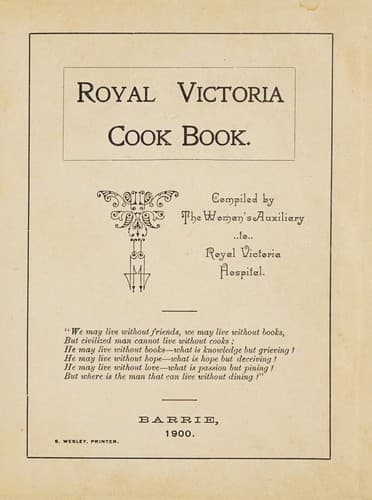
Royal Victoria cook book
1900Ont.). Woman's Auxiliary Royal Victoria Hospital (Barrie · 79 readable pages · 561 recipe records · community fundraising cookbook
From the librarian's dossier · AI-generated, grounded in the scanned text
The Royal Victoria Cook Book is a community fundraising cookbook compiled in 1900 by the Woman's Auxiliary of the Royal Victoria Hospital in Barrie, Ontario. Like many charitable cookbooks of its era, it gathers recipes contributed by local households to raise money for hospital supplies and comforts, blending practical domestic guidance with a sense of civic and charitable purpose. The book covers the full span of a turn-of-the-century household kitchen, moving from soups and fish through meats, vegetables, salads, puddings, pies, desserts, cakes, breads, beverages, confectionery, and even invalid cookery for the sick. With over 560 anchored food records, it offers a dense record of Victorian-era Canadian home cooking, emphasizing economy, technique, and the resourceful use of ingredients available to ordinary housekeepers. The recipes reflect contemporary tastes for elaborate molded dishes, cream sauces, and gelatine desserts alongside simple economical fare. Interspersed among the recipes are period advertisements, kitchen rules, time tables, and sample menus, giving modern readers a broader window into household management of the time. For readers today, the book serves as both a culinary artifact and a social document, revealing how a specific community organized domestic knowledge, entertainment, and care for the ill through the shared act of cooking.
The cookbook is organized by course and category in a fairly conventional sequence for its era: soups and fish open the book, followed by meats (beef, veal, poultry, game), sauces and relishes, vegetables and salads, puddings and pies, a broad dessert section, cheese dishes, breads and baked goods, cakes, and finally beverages, confectionery, and invalid cookery. The final section also includes practical household material such as kitchen rules, a cooking time table, sample breakfast and dinner menus, and period advertisements for local Barrie businesses and household equipment. Headings within sections mark specific dish types (for example SOUPS, FISH AND OYSTERS, CAKES, CONFECTIONERY), though some sections mix in advertisements and decorative material alongside recipes, reflecting the fundraising and community nature of the volume. Note that the provided summaries jump from section 6 to section 8, with no section 7 included in the supplied material.
Recipes from this book
561 records extracted from the text, showing the first 20 in reading order. Each links to a modern interpretation.
Read the book
79 readable pages. A dot marks pages with recipe records.