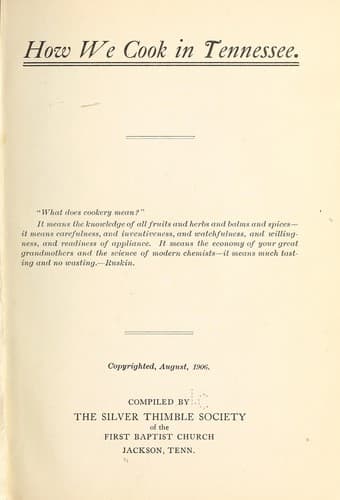
How we cook in Tennessee ..
1906Jackson (Tenn.). First Baptist Church. The Silver Thimble Society. · 174 readable pages · 1,031 recipe records · general household and community church cookbook
From the librarian's dossier · AI-generated, grounded in the scanned text
How We Cook in Tennessee is a 1906 community cookbook compiled by the Silver Thimble Society of the First Baptist Church in Jackson, Tennessee. Like many church and club fundraiser cookbooks of the period, it gathers recipes contributed by named individuals alongside material drawn from established culinary authorities and regional sources. The book moves through the full arc of a period kitchen's work, from stocks, soups, and fish through meats, game, eggs, and vegetables, into breads, cakes, puddings, frozen desserts, preserves, candy, and finally practical household matter such as beverages, pickles, remedies for the sick, and sample menus. With over one thousand anchored food records and only a single medicinal entry, the volume is overwhelmingly a cookery text, though it does include a small amount of household and invalid-care material typical of the genre. Modern readers will find a detailed portrait of turn-of-the-century Southern entertaining, including elaborate chafing dish suppers, molded salads, ice creams, and formal luncheon menus, alongside the everyday work of canning, pickling, and bread baking. The recipes are attributed largely to women contributors and church organizations, giving the book value both as a culinary record and as a document of communal domestic life in early twentieth-century Tennessee.
The book is organized into 16 numbered sections proceeding from soups and fish (sections 1-2) through oysters, sauces, and meats (sections 2-4), then chafing dish fare, sandwiches, and salads (section 5), vegetables and dressings (sections 6-7), cereals, breads, and measures (section 7), cakes and cake fillings (sections 8, 10-11), puddings and pastry (section 11), sweet sauces, fruit, and ice creams (sections 13-14), jellies, beverages, and preserves (section 15), canning and candy (section 16), pickles, remedies for the sick, poison antidotes, and miscellany (section 17), and finally sample menus, French culinary terms, and an index (section 18). Headings within sections mark clear category shifts (e.g., SOUPS, FISH, OYSTERS, CAKE, PUDDINGS, BEVERAGES, PICKLE, MISCELLANY), reflecting the standard structure of an early twentieth-century household cookbook.
Recipes from this book
1,031 records extracted from the text, showing the first 20 in reading order. Each links to a modern interpretation.
Read the book
174 readable pages. A dot marks pages with recipe records.