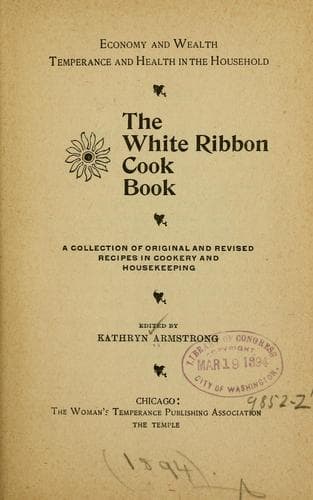
The white ribbon cook book
1894Kathryn Armstrong · 135 readable pages · 688 recipe records · general household cookbook with temperance and domestic reference material
From the librarian's dossier · AI-generated, grounded in the scanned text
The White Ribbon Cook Book (1894), attributed to Kathryn Armstrong, is a comprehensive household cookery manual produced under the banner of the temperance movement, its title referencing the white ribbon emblem of that cause. Organized in the tradition of Victorian domestic cookbooks, it moves systematically through soups, fish, poultry and game, meats, sauces, vegetables, salads, pickles, eggs, breads, cakes, pastry, puddings, desserts, candies, frozen treats, preserves, dairy, beverages, and sick-room cookery, closing with detailed nutritional reference tables. With 688 anchored food records, it offers a dense practical resource for middle and working-class households seeking economical, nourishing meals prepared without alcohol. The book blends everyday recipes such as soups, stews, and pies with more elaborate Victorian fare like charlottes, Nesselrode pudding, and iced cakes, alongside home canning, jelly-making, and dairy management instructions essential to self-sufficient household economy. Its beverages section notably favors non-alcoholic and medicinal drinks, consistent with temperance principles, and its sick-room cookery and nutritional tables reveal an interest in domestic health science. For the modern reader, it stands as both a practical period recipe collection and a window into the domestic ideology of the temperance movement, showing how food, health, and moral reform were intertwined in the late nineteenth-century American household.
The book proceeds through 14 sections that follow a broadly conventional Victorian cookbook arrangement: general cooking techniques and a time-table (section 1), soups (sections 1-2), fish and shellfish (section 2), poultry and game (sections 2-3), meats including curries and gravies (sections 3-5), sauces and stocks (section 5), vegetables, salads, and pickles (sections 5-7), eggs, catsups, and forcemeats (section 7), an extended bread and cake sequence (sections 7-9), pastry and puddings (sections 9-10), desserts, candies, and frozen treats (sections 10-12), preserves and canned fruits (sections 12-13), jellies, dairy, and cheese-making (section 13), beverages (section 13), and sick-room cookery with nutritional reference tables (sections 13-14). Headings within sections mark clear category boundaries (e.g., MEATS, VEGETABLES, DESSERT, BEVERAGES), and the final section functions as an appendix of digestion times, food composition, and household measures rather than a recipe chapter proper.
Recipes from this book
688 records extracted from the text, showing the first 20 in reading order. Each links to a modern interpretation.
Read the book
135 readable pages. A dot marks pages with recipe records.