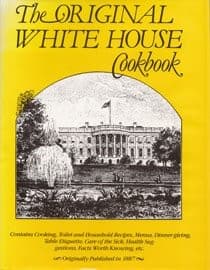
Original White House Cookbook
1887Hugo Ziemann, F. L. Gillette, Hugo Zimmerman, mrs gillette · 376 readable pages · 1,339 recipe records · general household cookbook and domestic encyclopedia
From the librarian's dossier · AI-generated, grounded in the scanned text
The Original White House Cookbook (1887), credited to Hugo Ziemann and Mrs. F. L. Gillette, is a sprawling late-Victorian household encyclopedia rather than a simple recipe collection. Across 38 sections it moves from meat carving and stock-making through soups, fish, shellfish, poultry, game, and every major meat category, then into sauces, salads, pickles, vegetables, breads, cakes, pies, custards, frozen desserts, puddings, preserves, candies, and beverages. Beyond the kitchen, it extends into invalid cookery, home medicine, cleaning and laundry work, toilet preparations, dyeing, kitchen equipping, table etiquette, and formal dinner-giving, closing with measurement tables and an index padded with period advertisements. With well over a thousand anchored food records plus a smaller cluster of household and medicinal entries, the book documents the full domestic ambition of an affluent American kitchen of the era, one that borrowed authority from the White House name while addressing ordinary housekeepers. Modern readers will find it a rich window into ingredient availability, servant-era cooking labor, and the era's blending of cookery with health and etiquette instruction. It is best approached not as a curated modern cookbook but as a reference volume meant to be consulted section by section, reflecting a period when a single household manual was expected to cover cooking, nursing, cleaning, and comportment together.
The book is organized as a sequence of thematic sections that begin with carving and stock fundamentals (section 1) and proceed systematically through soups, fish and shellfish, poultry and game, then each meat (beef, veal, lamb, pork) with associated preservation methods (sections 2 through 10). It then moves to sauces, salads, pickles and catsups, and vegetable cookery (sections 11 through 14), followed by cheese, eggs, and sandwiches (section 15), breads and quick breads (sections 16 through 18), and an extensive run of cake, frosting, pie, custard, gelatin dessert, ice cream, and pudding sections (sections 19 through 27). Preserving, canning, and confectionery follow (sections 28 through 30), then beverages, seasonal market charts, sample menus, and invalid cookery (section 31). The final third pivots away from food entirely into home medicine and remedies (sections 32 and 33), household cleaning and repair (sections 34 and 35), personal grooming and toilet preparations (section 36), textile dyeing and table etiquette and dinner-giving (section 37), and closes with measurement conversions, an index, and publisher advertisements (section 38).
Recipes from this book
1,325 records extracted from the text, showing the first 20 in reading order. Each links to a modern interpretation.
Read the book
376 readable pages. A dot marks pages with recipe records.