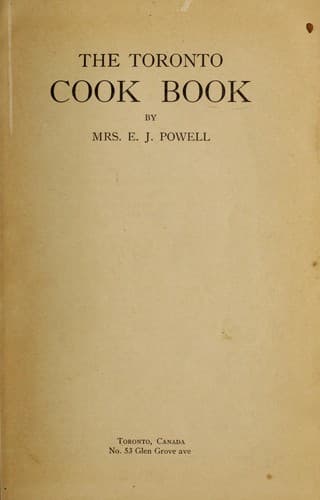
The Toronto Cook Book
1915Powell, E. J. Mrs.,d.b. 1853 · 186 readable pages · 1,308 recipe records · general household cookbook
From the librarian's dossier · AI-generated, grounded in the scanned text
The Toronto Cook Book (1915) is a comprehensive household cookery manual compiled by Mrs. E.J. Powell, offering well over a thousand recipes organized by category, from breads and cakes through soups, meats, fish, vegetables, preserves, and pickles. It opens with an introductory essay grounding household cookery in the science of nutrition, discussing water, proteids, fats, carbohydrates, and mineral salts, and pairs this with practical advice on household efficiency. The bulk of the book is a working kitchen reference, moving through baked goods, frozen and jellied desserts, salads, soups, seafood, meats and poultry, vegetables, and finally preserving, pickling, and a short closing section on home remedies and skincare. Recipes range from everyday staples like bread and biscuits to elaborate French-influenced dishes served at more formal tables, reflecting a household that cooked for both daily family meals and special occasions. Modern readers will find a snapshot of early twentieth-century Toronto domestic life, including brand-name products, imported culinary fashions, and attention to thrift alongside indulgence. The book stands as both a practical guide and a cultural document of its time and place, useful to anyone interested in the daily texture of Canadian home cooking a century ago.
The book is organized into clearly delineated food categories that build progressively through a meal and pantry structure: breads and yeast goods, breakfast and tea cakes, doughnuts and cookies, eggs and sandwiches, beverages, frozen and jellied desserts, small cakes and confections, larger cakes and frostings, pies and puddings, salads and salad dressings, soups and broths, fish and seafood (chowders, oysters, lobsters), fritters and croquettes, vegetables, meats and poultry (entrees, gravies, fillings), preserving and canning, and pickles and relishes. The final section departs from cookery to cover home remedies and skincare under 'Toilet Talk and the Sick Room.' Section headings within the summaries show the book uses named subsections (for example 'Pies,' 'Soups,' 'Fritters,' 'Meats, Fowl, Entrees, Gravies and Fillings') that likely correspond to the table of contents mentioned in section 1.
Recipes from this book
1,308 records extracted from the text, showing the first 20 in reading order. Each links to a modern interpretation.
Read the book
186 readable pages. A dot marks pages with recipe records.