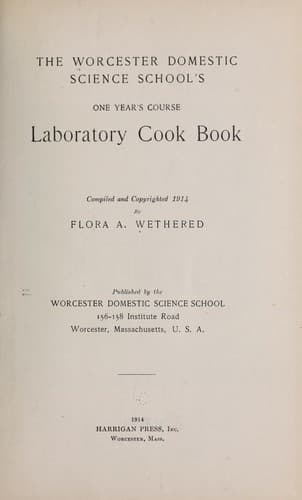
The Worcester domestic science school's one year course laboratory cook book
1914Worcester domestic science school, Worcester, Mass. · 134 readable pages · 554 recipe records · domestic science laboratory cookbook and household management manual
From the librarian's dossier · AI-generated, grounded in the scanned text
This 1914 laboratory cook book was produced by the Worcester Domestic Science School in Worcester, Massachusetts, as a working manual for its one-year cookery course. Rather than a leisure cookbook, it is a structured teaching text that moves from kitchen science and fuel management through preservation, everyday cookery, and on to formal entertaining. Readers encounter lecture-style introductions on combustion and stoves, detailed food chemistry basics, and hundreds of anchored recipes and preparations spanning canning, soups, meats, fish, eggs, salads, desserts, candies, and cakes. The book also extends beyond recipes into household management, covering fireless cookers, stain removal, cleaning methods, and formal dinner service and etiquette. With 554 anchored food records, it reflects a comprehensive early twentieth century domestic science curriculum aimed at training students in both practical cookery and household economy. Modern readers will find it a rich artifact of the Progressive Era home economics movement, blending scientific instruction with genteel entertaining standards. Its scope, from grape jelly to twelve-course dinner menus, makes it useful both as a historical cooking reference and as a window into how domestic science was formally taught to young women of the period.
The book is organized as a sequential course of lectures and laboratory lessons, beginning with kitchen fundamentals (fuels, stoves, food preservation) in sections 1 and 2, then moving through fish and shellfish, vegetables and soups, sandwiches and pastry, meats, salads and eggs, puddings and frozen desserts, candy and cake making, and finally household management and formal entertaining etiquette in the later sections. The sequence generally mirrors a teaching progression from basic principles to more elaborate preparations and social presentation, culminating in formal dinner protocols, sample menus, cleaning advice, and a bibliography.
Recipes from this book
554 records extracted from the text, showing the first 20 in reading order. Each links to a modern interpretation.
Read the book
134 readable pages. A dot marks pages with recipe records.