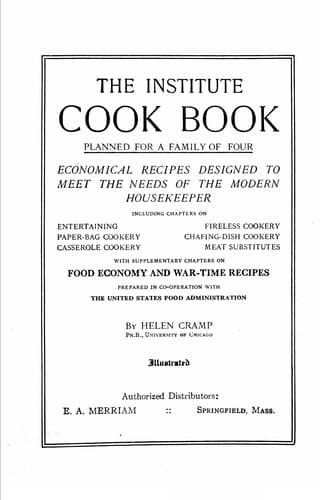
The Institute cook book
1913Helen Cramp · 195 readable pages · 1,040 recipe records · general household cookbook
From the librarian's dossier · AI-generated, grounded in the scanned text
The Institute Cook Book, published in 1913 by Helen Cramp, is a comprehensive American household cookery manual spanning appetizers, soups, fish, meats, poultry, vegetables, breads, cakes, desserts, candy, canning, and beverages. With over a thousand anchored recipe records, it reflects the ambitions of early twentieth-century domestic science, offering both refined dishes suited to formal entertaining and economical fare for everyday family meals. The book gives sustained attention to technique: proper stock-making, sauce building, pastry handling, cake mixing, and the mechanics of ice cream freezing and preserving. It also documents specialized cooking equipment of the era, including fireless cookers, paper-bag cookery, and chafing dishes, each treated with detailed procedural guidance. Notably, later sections (19 and 20) incorporate wartime food conservation material issued under Herbert Hoover's administration, showing how the book (or a later printing of it) was adapted to support rationing and substitution efforts during World War I. Recipes for invalid cookery and nutritional guidance for rationed diets round out the practical, health-conscious character of the text. Modern readers will find this book a rich record of period foodways, class-conscious entertaining customs, and the mix of science and thrift that defined American home cooking manuals of the 1910s.
The book proceeds from dining etiquette and appetizers (section 2) through soups, fish, and foundational meat cookery (sections 2 to 4), poultry, game, sauces, and eggs (section 5), meat substitutes and vegetables (sections 6 to 7), entrees, salads, and desserts (sections 8 to 9), breads and cakes (sections 11 to 12), cookies, pastries, pies, and sandwiches (section 13), candy and fruit preservation (section 14), canning, preserves, and beverages (section 15), fireless cooker and invalid cookery (sections 16 to 17), and paper-bag, chafing-dish, and casserole cookery with an index (section 18). Sections 19 and 20 form a distinct wartime conservation supplement covering substitutions, meal planning, and nutritional guidelines, suggesting later material was appended to the original text.
Recipes from this book
1,040 records extracted from the text, showing the first 20 in reading order. Each links to a modern interpretation.
Read the book
195 readable pages. A dot marks pages with recipe records.