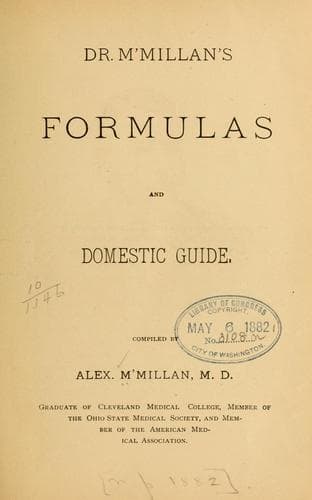
Dr. M'Millan's formulas and domestic guide
1882M'Millan, Alexander M. D. · 149 readable pages · 668 recipe records · general household guide combining domestic medicine and cookery
From the librarian's dossier · AI-generated, grounded in the scanned text
Dr. M'Millan's Formulas and Domestic Guide (1882) is a sprawling American household manual that blends home medicine with everyday cookery. Written by a physician, it promises roughly two thousand recipes covering medicines, farriery (animal care), cookery, toilet preparations, and miscellaneous domestic formulas. Readers encounter tonics, purgatives, liniments, and ointments alongside beef tea and invalid cookery for the sick, then move into mainstream kitchen fare: cakes, breads, puddings, pies, soups, poultry, meats, vegetables, and salads. The book closes with a wide array of household chemistry, from dyeing textiles to cleaning silver, tanning skins, making soap, and even instructions for building an aeolian harp, plus a section of moral maxims. The anchored records confirm this breadth: 668 food entries dominate, with 78 medicinal formulas and 14 household items rounding out the collection. This is a domestic guide in the fullest 19th-century sense, treating the household as a single unit requiring medical, culinary, and practical management under one roof. For modern readers, it offers a window into how a rural or small-town American family might have addressed illness, hunger, and housekeeping simultaneously, often through the same trusted printed authority, reflecting an era before clear boundaries between professional medicine and domestic self-sufficiency.
The book is organized into numbered sections that move from an index and preface (section 1) through a long medical core covering tonics, poultices, tinctures, and invalid cookery (sections 1, 3-6). A 'Farrier's Division' for veterinary remedies and a 'Baker's Division' mark an explicit shift into cookery (section 6), which then expands across several sections into cakes, pies, puddings, breads, soups, fish, poultry, meats, vegetables, salads, and beverages (sections 7-13). The final available section (15) broadens into household chemistry and management: pickling and canning, cleaning agents, stain removal, dyeing, soap making, personal care items, and closes with moral maxims. Headings within sections are recipe or remedy titles printed in capitals, suggesting a dictionary-like, browsable arrangement rather than strict narrative chapters.
Recipes from this book
651 records extracted from the text, showing the first 20 in reading order. Each links to a modern interpretation.
Read the book
149 readable pages. A dot marks pages with recipe records.