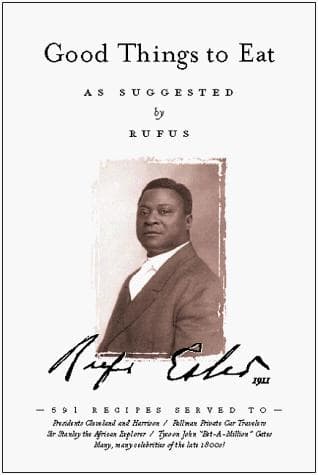
Good Things to Eat as Suggested by Rufus
1911Rufus Estes · 94 readable pages · 533 recipe records · general household cookbook
From the librarian's dossier · AI-generated, grounded in the scanned text
Good Things to Eat as Suggested by Rufus (1911) is a working cookbook compiled by Rufus Estes, a chef whose biographical sketch describes his path from slavery to renown as a cook for the Pullman Company and U.S. Steel subsidiaries, where he served prominent guests including Presidents Cleveland and Harrison. The book opens with a foreword, that biographical sketch, and practical hints for kitchen maids, before moving into roughly five hundred anchored recipes covering soups, fish, meats, poultry, vegetables, sauces, breads, cakes, desserts, preserves, and beverages. It closes with an alphabetical index. The recipes blend French technique with American household practice, offering both everyday fare like griddle cakes and Boston baked beans alongside more elaborate dishes such as chicken timbales, jellied chicken, and marbled chicken suited to formal dining. Throughout, Estes emphasizes careful seasoning, browning, sauce-making, and economical use of leftovers. For a modern reader, this book offers a window into early twentieth-century American cooking as practiced by a professional Black chef working in elite railroad and industrial dining settings, presented as a practical manual for home cooks and domestic staff alike.
The book begins with front matter (section 1): a foreword, Estes' biographical sketch, hints to kitchen maids, and a table of weights and measures, followed immediately by soups and fish. From there it proceeds through a logical sequence of courses and categories: meats and offal (section 2), chicken and stuffings with sandwiches (section 3), vegetables, game, eggs, and condiments (section 4), more vegetables and sauces (section 5), sauces, breads, rolls, muffins, and pies (section 6), custards, cakes, pastries, and candies (section 7), confections, ice creams, preserves and pickles, and souffles (section 8), cake fillings, puddings, sauces, and beverages (section 9), and finally an alphabetical index from A through W (section 10). The organization mirrors a household's meal structure and kitchen tasks rather than a strict alphabetical dictionary format until the closing index.
Recipes from this book
533 records extracted from the text, showing the first 20 in reading order. Each links to a modern interpretation.
Read the book
94 readable pages. A dot marks pages with recipe records.