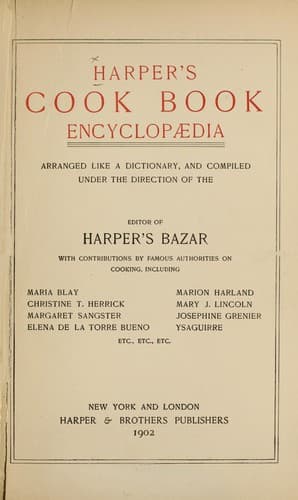
Harper's cook book encyclopædia
1902499 readable pages · 1,785 recipe records · alphabetical culinary dictionary and household cookbook
From the librarian's dossier · AI-generated, grounded in the scanned text
Harper's Cook Book Encyclopaedia is a 1902 American culinary reference organized as an alphabetical dictionary rather than a narrative cookbook. Spanning nearly 1,800 anchored food entries across 49 sections, it moves from basic reference material (time-tables, weights and measures, kitchen equipment) through an exhaustive alphabetical sweep of dishes, from Agrodolce and almonds at the start to vegetables, potatoes, and rice at the close. Along the way it covers beef, poultry, game, fish and shellfish, eggs, force-meats, fruit desserts, cakes, candies, pastries, preserves, soups, sauces, salads, and offal cookery such as sweetbreads and calf's brains. The book reflects the formal, French-influenced standards of turn-of-the-century American household cooking, with attention to classical techniques like larding, trussing, clarifying stock, and tempering egg whites. It is as much a kitchen reference work as a recipe collection, offering guidance on economy, invalid cookery, and chafing-dish preparation alongside thousands of individual dishes. Modern readers will find it a detailed window into affluent American domestic cuisine of 1902, valuable both for its recipes and for what it reveals about period expectations of a well-run kitchen.
The book is arranged alphabetically by ingredient or dish name, dictionary-style, beginning with introductory reference material (cook's time-tables, weights and measures, baking proportions, kitchen utensils, kitchen economy) in section 1 before proceeding through entries from Agrodolce and Almonds onward. Sections group naturally by letter and topic clusters as the alphabet progresses: beef and beverages (sections 2 to 4), breads and cakes (sections 4 to 8), candies and cheese (sections 9 to 10), creams, custards, and eggs (sections 10 to 13), fish and shellfish (sections 13 to 17), force-meats and fruit desserts (sections 18 to 21), game and gravies (sections 21 to 23), frozen desserts and jellies (sections 23 to 25), mutton, pickles, and pies (sections 26 to 30), pork and poultry (sections 30 to 33), preserves and puddings (sections 33 to 36), salads, sauces, and sausages (sections 37 to 40), soups (sections 41 to 43), sweetbreads and veal (sections 44 to 46), and vegetables and potatoes closing the volume (sections 46 to 49). Many sections end with brief index-like cross-references pointing to related entries elsewhere in the book.
Recipes from this book
1,785 records extracted from the text, showing the first 20 in reading order. Each links to a modern interpretation.
Read the book
499 readable pages. A dot marks pages with recipe records.