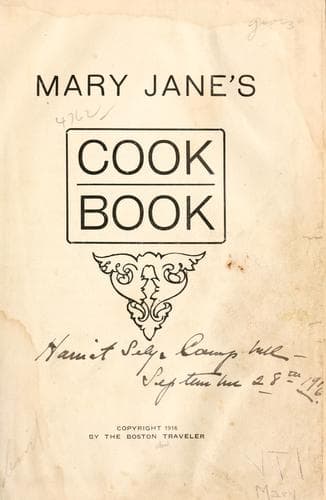
Mary Jane's cook book
1916Mary Jane, Sophie D. Coe · 133 readable pages · 933 recipe records · general household cookbook
From the librarian's dossier · AI-generated, grounded in the scanned text
Mary Jane's Cook Book (1916) is a large American household cookbook attributed to Mary Jane and Sophie D. Coe, containing hundreds of anchored food records across fourteen sections. It moves through the full range of domestic cookery expected in an early twentieth-century kitchen: beverages and breads, an enormous array of cakes, cookies, candies, and frozen desserts, followed by preserving and pickling, meats and poultry, sauces and stuffings, pies, salads and dressings, sandwiches, soups, and vegetable cookery, concluding with an index and a short chapter on foraging edible wild greens. Many recipes are credited to named contributors, often identified by town, suggesting the book drew on community submissions rather than a single professional voice. The scope is domestic and practical, aimed at the home cook managing everything from festive punches to everyday vegetable sides. A notable feature is a wartime insert on wheat flour substitutes with 1918 pricing, showing the book was updated or used across the World War I period. For modern readers, it offers a detailed window into the ingredients, techniques, and social conventions of American home cooking in the 1910s, including attitudes toward home remedies and foraged foods reflected in the closing 'Edible Weeds' chapter.
The book is organized as a sequence of thematic chapters rather than a single alphabetical dictionary. It opens with beverages and yeast breads (section 1), then moves through quick breads, muffins, and early cakes (section 2), continues into layer cakes, fillings, frostings, and candies (sections 3 and 4), then cookies and steamed or baked puddings (section 5), followed by custards, jellies, and molded desserts (section 6). Sauces, seafood, and frozen desserts appear in sections 7 and 8, alongside fried cakes, griddle items, and appetizers. Preservation work, including jams, jellies, marmalades, and pickles, occupies sections 9 and 10, which then shifts into meat and poultry cookery. Sauces, stuffings, croquettes, and an extensive pie chapter follow in section 11. Salads, dressings, sandwiches, and soups appear in section 12, with soups continuing and vegetable preparations dominating section 13, which also contains the book's alphabetical index. A final short section (14) closes the index and adds a standalone chapter on edible wild greens and a few salad recipes. Headings throughout the summaries show named recipe titles used as running heads, and many entries are credited to contributors by name and location, indicating a community-sourced structure layered onto the standard chapter divisions of a general household cookbook.
Recipes from this book
933 records extracted from the text, showing the first 20 in reading order. Each links to a modern interpretation.
Read the book
133 readable pages. A dot marks pages with recipe records.