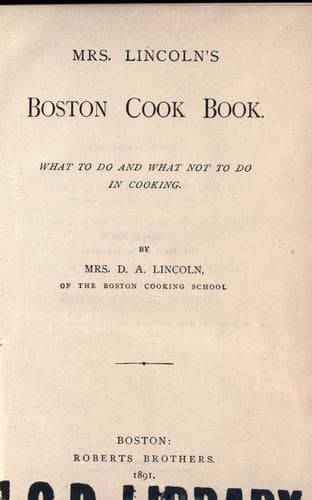
Mrs. Lincoln's Boston cook book
1884Lincoln, Mary Johnson Bailey "Mrs. D. A. Lincoln," · 315 readable pages · 678 recipe records · general household cookbook with domestic science and cooking school curriculum
From the librarian's dossier · AI-generated, grounded in the scanned text
Mrs. Lincoln's Boston Cook Book (1884) is a comprehensive household and instructional cookbook written by Mary Johnson Bailey Lincoln, associated with the Boston Cooking School. It combines practical recipes with scientific explanations of cooking chemistry, nutrition, and physiology, aiming to serve both cooking school pupils and ordinary housekeepers of varying skill levels. The book covers an enormous range of topics: fire and stove management, bread-making chemistry, soups and stocks, fish and shellfish, meats and poultry, vegetables, pastries, puddings, frozen desserts, cakes, preserves and pickles, invalid cookery, and a substantial theoretical section on digestion and food composition. It closes with glossaries, kitchen equipment lists, cooking school curricula, and an index, alongside period advertisements. The text reflects a distinctly didactic approach, frequently explaining the underlying scientific 'why' behind techniques rather than offering recipes alone. Readers today will find both a working recipe collection and a window into how domestic science was taught to American women in the 1880s, blending household economy with emerging nutritional science. The book's dual audience, cooking school students and home cooks, shapes its unusually thorough explanatory style throughout.
The book proceeds from foundational science and technique (fire, heat, boiling, frying, measuring, bread chemistry) through categories of food in roughly the order a cook might need them: breads and breakfast cakes, beverages, soups and stocks, fish and shellfish, eggs, meats (beef, mutton, lamb, veal, pork), poultry and game, leftover and rechauffe dishes, vegetables, salads, pastry, puddings, custards and jellies, frozen desserts, cakes, fruit preserving and pickling, and invalid cookery. It then shifts into an extended theoretical section on nutrition, digestion, and food composition intended for teachers and students, followed by cooking school curricula, examination questions, glossaries, kitchen equipment lists, a general index, and finally back-matter advertisements from Boston-area suppliers.
Recipes from this book
678 records extracted from the text, showing the first 20 in reading order. Each links to a modern interpretation.
Read the book
315 readable pages. A dot marks pages with recipe records.