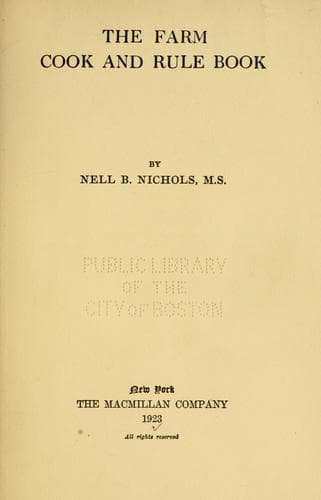
The farm cook & rule book
1923Nell Beaubien Nichols · 144 readable pages · 626 recipe records · general household and farm cookbook with domestic economy guide
From the librarian's dossier · AI-generated, grounded in the scanned text
The Farm Cook and Rule Book (1923) by Nell Beaubien Nichols is a comprehensive household manual written for rural American women who, unlike their urban counterparts, still had to bake bread, cure meat, preserve produce, make soap, and manage a household economy largely without commercial services. The book blends standardized, modernized recipes with traditional farm skills, reflecting the era's push toward scientific home economics even in remote settings. It moves from everyday cookery (breads, cakes, desserts, meats, vegetables) through preservation techniques (canning, pickling, vinegar-making, candying) to broader domestic subjects like laundering, soap-making, home equipment, beauty remedies, and cooking for invalids. With 626 anchored food records and only 3 household records, its overwhelming focus is culinary, though it is bordered by substantial non-recipe household guidance. Readers today will find it a detailed snapshot of interwar rural domestic life, valuable both as a cooking resource and as a record of self-sufficient farm household management. The tone throughout is practical and instructional, aimed at preventing waste and ensuring reliable results through precise measurement, a notably progressive concern for a cookbook rooted in older farmhouse traditions.
The book proceeds from introductory measurement and equivalence guidance (section 1) through beverages, then a long sequence of baked goods: yeast breads, quick breads, cakes, cookies, doughnuts, and cereals (sections 1-3). It then shifts into preservation topics including candied fruits, canning, pickles, relishes, jellies, and jams (sections 4-5), followed by frozen desserts, gelatin dishes, eggs and cheese, and cake icings (sections 6-7). Mains follow: meats, poultry, fish, and wild game, then pastry, salads, and sandwiches (sections 7-9). Soups, sauces, and vegetable cookery lead into vinegar-making and large-quantity cooking for farm crews (sections 9-10). The second half turns to household management: meat curing and smoking, soap-making, cleaning, laundering, home equipment, kitchen tools, and beauty remedies (sections 11-14), closing with a dedicated section on cooking for invalids and a full alphabetical index (section 15). Headings within sections mirror this movement from cookery to broader domestic economy.
Recipes from this book
623 records extracted from the text, showing the first 20 in reading order. Each links to a modern interpretation.
Read the book
144 readable pages. A dot marks pages with recipe records.