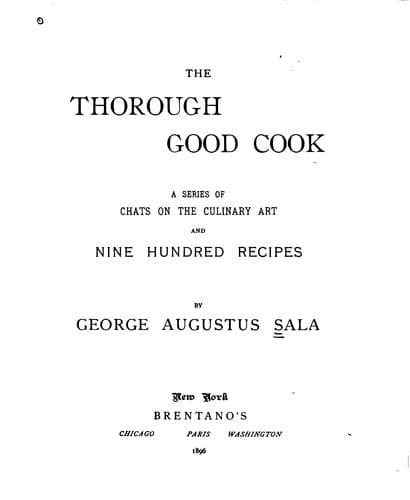
The thorough good cook
1895George Augustus Sala · 264 readable pages · 772 recipe records · general household cookbook with international culinary survey
From the librarian's dossier · AI-generated, grounded in the scanned text
The Thorough Good Cook is an 1895 culinary compendium by George Augustus Sala, a Victorian journalist and self-described lifelong student of cookery who claims fifty-five years of personal recipe testing. Aimed at general readers, ladies who manage households, and the working cooks who staff Victorian kitchens, the book blends practical English domestic cookery with surveys of Greek, Russian, French, American, German, and Spanish cuisines. It opens with discursive essays on national eating habits, breakfast customs, and kitchen philosophy before settling into a long, methodically numbered sequence of recipes covering soups, fish, entrees, roasts, game, sauces, vegetables, salads, savouries, puddings, ices, drinks, and preserves. The scale is considerable, with anchored records showing roughly 772 identifiable food recipes and a single household record. Sala writes with strong personal opinions throughout, criticizing excessive meat at breakfast, defending broiling over frying, and confessing a dislike of potatoes even as he instructs on their preparation. The book closes with sections on American breakfast dishes, porridges, fruit preservation, and a detailed alphabetical index. Readers today will find it a rich window into upper-middle-class Victorian dining, combining formal French technique with English tradition and international curiosity, all filtered through one opinionated author's voice.
The book opens with a three-part preface addressed separately to the general reader, the lady of the house, and the household cook, followed by discursive chapters surveying Greek, Russian, French, American, German, and Spanish cuisines and topics like breakfast, salads, curry, and old-fashioned puddings (sections 1 through 6 roughly). It then shifts into a long numbered recipe sequence organized by course and ingredient, moving through soups (sections 7 and 8), fish and shellfish including salmon, whiting, oysters, crab, and lobster (sections 10 through 12), entrees of poultry, game, and meat (sections 13 and 14), roasts and poultry (section 15), game birds (sections 16 and 17), further beef and mutton dishes with curries and sauces (section 18), an extensive sauce chapter (sections 19 and 20), vegetables, salads, and hors-d'oeuvres (sections 20 and 21), and finally desserts, puddings, ices, drinks, miscellaneous preparations, American breakfast dishes, porridges, and fruit preservation (sections 23 through 25). The book closes with a general index (section 27). Numbered section headings such as SECTION IV, SECTION VII, and SECTION XV mark formal divisions by course, and recipes within them are individually numbered for easy reference.
Recipes from this book
772 records extracted from the text, showing the first 20 in reading order. Each links to a modern interpretation.
Read the book
264 readable pages. A dot marks pages with recipe records.