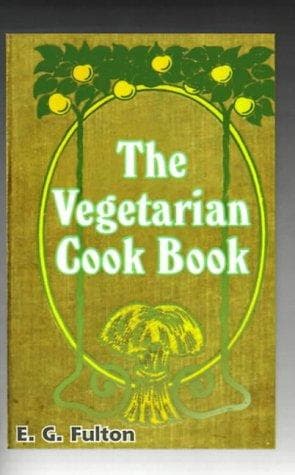
Vegetarian Cook Book
1904E. G. Fulton, Edward Fulton · 103 readable pages · 492 recipe records · vegetarian household cookbook with health-reform and domestic-science guidance
From the librarian's dossier · AI-generated, grounded in the scanned text
The Vegetarian Cook Book (1904) by E. G. Fulton and Edward Fulton is a comprehensive household manual advocating meatless cooking as both a health philosophy and a practical culinary system. Rooted in the Battle Creek Sanitarium tradition, the book opens by asserting that wholesome diet prevents illness more effectively than medical treatment, then proceeds through an enormous range of material: cooking science, soups, meat-substitute entrees built from proprietary products like protose, nuttolene, and nut cero, vegetable cookery, sauces, salads and dressings, breads and grains, egg and dairy dishes, sandwiches, nut preparations, frozen desserts and preserves, and finally kitchen equipment, nutrition science, and table etiquette. With nearly 500 anchored food records, it functions as both a recipe collection and a lifestyle guide, closing with an index and advertisements for Sanitarium foods and health publications that reveal its commercial and institutional origins. Modern readers will find it a rich artifact of turn-of-the-century reform cooking, blending Victorian domestic science with early industrial meat-substitute products. It is less a narrative cookbook than a systematic household reference, moving from theory to technique to hundreds of specific dishes, then to service and nutritional guidance. The book rewards browsing rather than cover-to-cover reading, and offers a window into how vegetarianism was marketed and practiced in early 1900s America.
The book is organized as a progressive household manual rather than a strict alphabetical dictionary. It begins with hygienic and scientific principles of cooking (section 1), then moves into main dishes and meat-substitute entrees (sections 2-3), core vegetable cookery (sections 3-4), sauces, salads, and dressings (sections 4-5), baking and bread chemistry (section 7), egg, dairy, sandwich, and nut preparations (section 8), preservation and frozen desserts (section 9), and concludes with nutrition science, etiquette, and a detailed index with manufacturer advertisements (sections 10-11). Recipes are grouped by course and ingredient type, with headings that function as sub-chapter markers (e.g., soups, protose dishes, salads, toasts). The final sections double as a practical index and a promotional appendix tied to the Battle Creek Sanitarium diet system.
Recipes from this book
492 records extracted from the text, showing the first 20 in reading order. Each links to a modern interpretation.
Read the book
103 readable pages. A dot marks pages with recipe records.