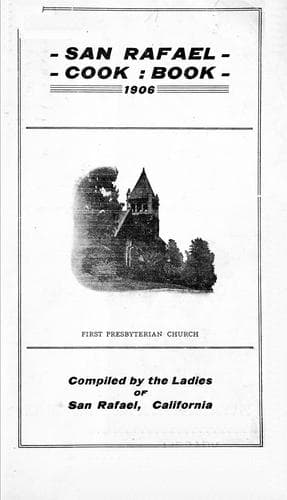
San Rafael cook book, 1906
1906Katherine Golden Bitting Collection on Gastronomy (Library of Congress) · 99 readable pages · 661 recipe records · community fundraising household cookbook
From the librarian's dossier · AI-generated, grounded in the scanned text
The San Rafael Cook Book (1906) is a community fundraising cookbook compiled by the First Presbyterian Church Ladies of San Rafael, California. Like many charitable cookbooks of its era, it gathers recipes contributed by named local women alongside advertisements from San Rafael businesses, creating a snapshot of a prosperous early twentieth-century California town. The book covers an enormous range of dishes, from everyday breads, soups, and meats to elaborate frozen desserts, wedding cakes, and candies, reflecting both practical household cooking and the more elegant entertaining styles of the Edwardian period. Readers will find hundreds of food recipes (661 anchored records) alongside a small number of medicinal preparations intended for the sick. The compilers organized the book by course and category, moving from foundational techniques like bread and stock making through meats, vegetables, salads, sweets, preserves, and finally household tips and remedies. Attributions to specific contributors throughout give the book a strong local, communal character rather than the voice of a single author. This is a useful primary source for understanding regional American home cooking, church fundraising publishing traditions, and the culinary aspirations of a California community at the turn of the twentieth century.
The book proceeds by culinary category, beginning with introductory bread-making rules and recipes (section 1), then moving through meats and composed meat dishes (section 3), sauces, dressings, vegetables, and salads (section 4), further salad dressings, cheese, and egg dishes with an early pudding section (section 5), an extensive run of puddings and light desserts (section 6), frozen desserts and cakes (section 7), more cakes, pastries, pies, and pickles (section 9), and finally preserves, candies, beverages, food for the sick, and household miscellany (section 10). Each section mixes recipes with local advertisements, and many recipes carry the names of individual contributors, reinforcing the book's identity as a community compilation rather than a single-author work. Numbered section headings within the original text (such as RULES FOR MAKING BREAD, RULES FOR CAKE, JELLIES AND FRUITS) mark transitions between major categories.
Recipes from this book
660 records extracted from the text, showing the first 20 in reading order. Each links to a modern interpretation.
Read the book
99 readable pages. A dot marks pages with recipe records.