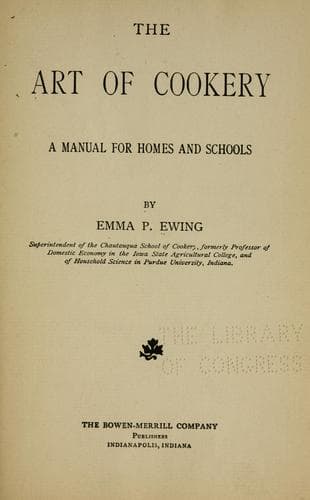
The art of cookery
1899Emma P. Ewing · 161 readable pages · 681 recipe records · general household cookbook
From the librarian's dossier · AI-generated, grounded in the scanned text
The Art of Cookery (1899) by Emma P. Ewing is a comprehensive American household cookbook that moves systematically from marketing and food selection through cooking methods, baking, and finally serving and menu planning. With 681 anchored food records, it offers a dense catalog of recipes and techniques spanning meats, vegetables, soups, sauces, breads, pastries, puddings, cakes, salads, entrees, and eggs, alongside guidance for invalid cookery and home canning and preserving. Ewing writes with an instructional, almost textbook voice, explaining the reasoning behind techniques such as searing meat before roasting, scalding corn-meal to develop flavor, or selecting sauces appropriate to a given dish. The book reflects the era's transition toward coal range cookery and modern milling, while still preserving older practices like liquid yeast-making and sick-room cookery. It closes with carving instructions, sample bills of fare for dinners and breakfasts, and an alphabetical index, making it as much a guide to running a household kitchen as a recipe collection. Modern readers will find it a rich window into turn-of-the-century domestic science, written for a literate home cook expected to understand both the practical and the underlying scientific principles of food preparation.
The book is organized into numbered parts and chapters that follow the logical sequence of a meal's production: Part I covers marketing and food selection (section 1); Part III addresses cooking methods such as broiling, baking, boiling, stewing, and frying (sections 2 to 7); this is followed by chapters on invalid cookery and canning/preserving (section 8); Part IV covers mixing, including bread-making and pastry (sections 9 to 11); dessert-related chapters cover pudding sauces, cake-making, and delicate desserts (section 12); Part V addresses seasoning and salad-making along with entrees (sections 13 and 14); and the book closes with egg cookery, carving, Part VI on serving and garnishing, bills of fare, and an alphabetical index (sections 15 and 17). Section 16 appears to be missing from the provided material, with section 17 being the index continuation.
Recipes from this book
681 records extracted from the text, showing the first 20 in reading order. Each links to a modern interpretation.
Read the book
161 readable pages. A dot marks pages with recipe records.