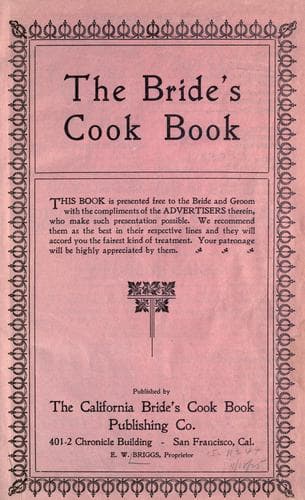
The bride's cook book
1915Edgar William Briggs · 138 readable pages · 618 recipe records · general household cookbook with bound-in wartime conservation and advertising booklet
From the librarian's dossier · AI-generated, grounded in the scanned text
The Bride's Cook Book (1915) is a promotional household cookbook credited to Edgar William Briggs, distributed as a gift to newlyweds through San Francisco merchants. It blends conventional early twentieth-century American cookery, covering meats, poultry, fish, soups, sauces, preserves, and desserts, with a strong overlay of World War I era food conservation guidance. The book carries a United States Food Administration approval letter and repeatedly promotes wheat, sugar, and fat substitutions such as barley, corn, rice, oat and buckwheat flours, and corn syrup. A substantial portion of the later book is not general recipe content at all but a bound-in Del Monte Conservation Recipes booklet promoting canned fruits and vegetables, complete with a packing plant map and additional advertisements. Interspersed throughout are period advertisements for furniture, phonographs, cameras, photography studios, and a savings bank, underscoring the book's origin as a commercial gift item rather than a purely instructional text. Housekeeping notes on cleaning, stain removal, and household maintenance round out the front matter. Modern readers will find this a layered artifact: part domestic manual, part wartime propaganda for food substitution, and part corporate advertising vehicle, offering a window into how commerce, government policy, and home economy intersected in an American kitchen guide of the period.
The book opens with front matter combining housekeeping guidance (floor care, stain removal, dish washing) with a Food Administration approval letter and rationing rules (section 1). It then moves through measurement and menu guidance, substitute flour bread instructions, and cooking time tables (section 2), followed by an extensive run of alternative grain baked goods including muffins, griddle cakes, and cakes contributed by milling companies (section 3). Dessert chapters follow, covering pies, puddings, custards, frozen desserts, and sauces across sections 4 and 5, before the book turns to fish and shellfish (section 5), oysters, poultry, game, and salad dressings (section 6), then stocks, soups, and beef and mutton cuts and preparations (section 7), and further meat cookery including meat substitutes made from beans, peas, lentils, and nuts (section 8). Sauces, pickles, preserves, eggs, and vegetable cookery follow (section 9), then home canning, jelly and jam making, beverages, and confections (section 10). The final third of the book, sections 11 through 14, consists largely of a separately bound Del Monte Conservation Recipes booklet organized by canned product (apricots, cherries, peaches, pears, pineapple, plums, prunes, asparagus, chile peppers, peas, pimientos, pumpkin, squash, spinach, string beans, tomatoes, olives, and raisins), each with suggestions and recipes, concluding with a packing plant map and advertisements.
Recipes from this book
617 records extracted from the text, showing the first 20 in reading order. Each links to a modern interpretation.
Read the book
138 readable pages. A dot marks pages with recipe records.