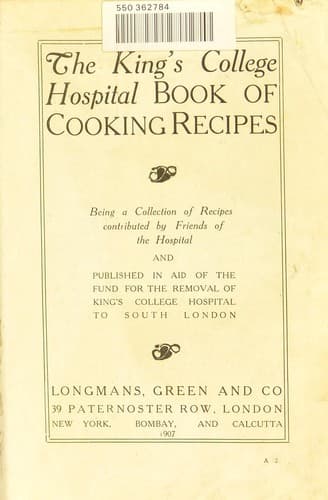
The King's College Hospital book of cooking recipes
1907King's College Hospital · 109 readable pages · 670 recipe records · general household cookbook
From the librarian's dossier · AI-generated, grounded in the scanned text
This 1907 cookbook was compiled by King's College Hospital as a charitable fundraiser to support the hospital's removal to South London, drawing its recipes from friends and patrons of the institution. It is a substantial household collection of over 670 food records, organized in the familiar Edwardian manner from soups and fish through meats, curries, vegetables, puddings, preserves, and beverages. The book reflects the cosmopolitan tastes of a genteel contributing readership, mixing traditional British dishes like Yorkshire Pudding and Bubble and Squeak with colonial curries, Continental pastries, and dishes bearing French names. Each recipe is credited to its contributor, giving the volume a communal, almost scrapbook-like character beneath its formal structure. Later sections shift markedly in tone, appending wartime food economy guidance centered on potatoes as a bread and meat substitute, along with household hints, invalid cookery, and a detailed index. A small number of medicinal and household entries appear alongside the food recipes, showing the book's practical, all-purpose domestic scope. For the modern reader, it offers both a window into Edwardian kitchen practice among comfortable households and a later glimpse of wartime austerity cooking appended to the same volume, making it a layered historical document as much as a working recipe book.
The book proceeds through standard courses in sequence: soups (section 1), fish and sauces (section 2), meats and curries (sections 2 to 3), vegetables, poultry, game, and breakfast savouries (section 4), savory dishes and puddings (section 5), cold sweets and creams (sections 6 to 7), cakes, preserves, chutneys, pickles, and ices (section 9), beverages, miscellaneous household items, invalid foods, and an index (section 10), and finally a distinct appended block of wartime potato cookery and economy advice (section 11). Recipes are grouped under course headings and are individually credited to contributors, reflecting the book's origin as a collective charitable compilation rather than a single author's work.
Recipes from this book
669 records extracted from the text, showing the first 20 in reading order. Each links to a modern interpretation.
Read the book
109 readable pages. A dot marks pages with recipe records.