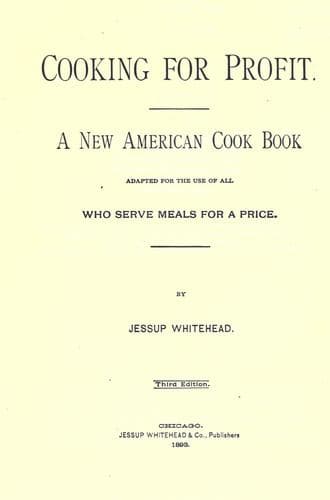
Cooking for profit
1886Jessup Whitehead · 372 readable pages · 816 recipe records · commercial hotel and restaurant trade cookbook
From the librarian's dossier · AI-generated, grounded in the scanned text
Cooking for Profit is an 1886 professional cookbook by Jessup Whitehead, written for hotel cooks, restaurant operators, boarding house keepers, and lunch counter proprietors rather than home cooks. Drawing on the author's stated thirty years of experience, the book blends hundreds of numbered recipes with running commentary on kitchen economics, ingredient costing, and the daily realities of feeding paying guests. Readers encounter everything from showcase bakery items and ice creams to oyster house dishes, hotel dinners, and elaborate banquet pieces, but the book's real distinguishing feature is its constant attention to price per plate, cost per serving, and the tension between quality and profitability. Much of the text takes the form of a season-long narrative diary from a summer resort hotel, recording actual menus, guest counts, and costs day by day, interspersed with anecdotes about staff, equipment failures, and troublesome ingredients. Later sections turn toward more ornamental and aspirational cookery, including exhibition pieces from a London food show and elaborate galantines, before closing with publisher advertisements for Whitehead's other trade cookbooks. The result is both a working recipe manual and an informal record of commercial food service in late nineteenth-century America.
The book opens with foundational material on measures and showcase bakery items before moving through thematic runs of recipes: oysters and fish house dishes, restaurant breakfasts and lunches, hotel dinners, ice cream and frozen desserts, bakery and yeast goods, shellfish, confectionery, and beverages including homemade beers. From roughly the midpoint onward the structure shifts into an extended chronological narrative, presenting day-by-day menus and cost breakdowns from a summer resort hotel and later a boarding house, covering many weeks of service with real guest counts and per-plate prices. The closing sections move into ornamental and exhibition cookery, including coverage of the 1885 London Cookery and Food Exhibition, decorated cakes, galantines, and aspics, followed by an appendix of restaurant anecdotes, wine service notes, and truffle information. The volume ends with publisher advertisements listing Whitehead's companion cookery books.
Recipes from this book
816 records extracted from the text, showing the first 20 in reading order. Each links to a modern interpretation.
Read the book
372 readable pages. A dot marks pages with recipe records.