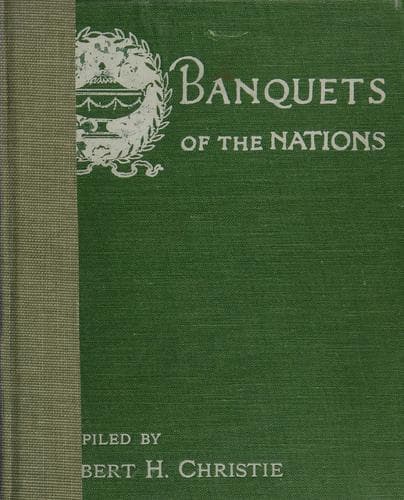
Banquets of the nations
1911Robert H. Christie · 272 readable pages · 1,116 recipe records · international culinary compendium arranged by nation, with menus and dining customs
From the librarian's dossier · AI-generated, grounded in the scanned text
Banquets of the Nations (1911) is an ambitious international cookbook compiled by Robert H. Christie, organized around the conceit of eighty-six characteristic dinners representing distinct countries and peoples around the world. Rather than a conventional household manual, it functions as a comparative culinary tour, moving alphabetically-by-nation through complete menus and recipes from Afghanistan to Turkey, with stops through China, India's many regions, the Middle East, Scandinavia, the Americas, Africa, and the Pacific. Christie draws on consuls, missionaries, and reference works to assemble dishes he presents as authentic to each culture, while adapting most into Western-style courses for European kitchens. The book pairs detailed recipes with descriptions of dining customs, table protocols, and service rituals, particularly for Eastern and Middle Eastern traditions where communal or simultaneous service differed markedly from Western sequential courses. Readers will find an enormous range of dishes, from bird's nest soup and shark's fin preparations to haggis, couscous, mulligatawny, and Benedictine liqueur. The scope and specificity, along with transliterated foreign-language recipe titles, make this both a period culinary reference and an artifact of early twentieth-century ethnographic curiosity about food. It closes with practical sections on paper bag cookery and a soup index.
The book is organized as a sequence of numbered national or regional sections (originally numbered with Roman numerals, such as Afghanistan, Africa South, Algiers, America, Arabia, Argentine, Armenia, and so on through the alphabet to Turkey), each opening with a sample menu followed by recipes for that menu's dishes. Some countries with large or varied cuisines are subdivided further, as with China (North-West and South-East), India (broken into numerous regional and religious traditions such as Bengali, Brahmin, Mussulman, Kashmir, Madras, Mysore, Punjab, and Rajputana), and Palestine (Arab and Hebrew). The opening section (section 1) sets out the compiler's method and surveys dining customs across many cultures before the country-by-country recipe sections begin. The book concludes with miscellaneous techniques such as paper bag cookery and an index of soups by origin (section 28).
Recipes from this book
1,116 records extracted from the text, showing the first 20 in reading order. Each links to a modern interpretation.
Read the book
272 readable pages. A dot marks pages with recipe records.