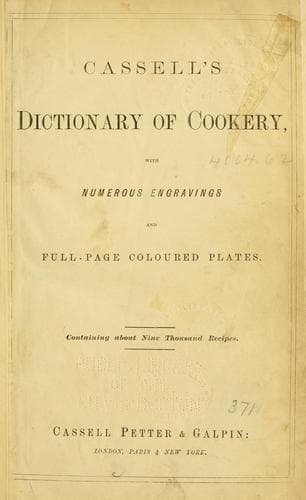
Cassell's dictionary of cookery
1892Cassell & Company · 2,372 readable pages · 6,256 recipe records · alphabetical culinary dictionary
From the librarian's dossier · AI-generated, grounded in the scanned text
Cassell's Dictionary of Cookery (1892) is a monumental Victorian culinary encyclopedia, organized alphabetically like a true dictionary rather than by course or meal. Compiled by Cassell & Company, it collects several thousand recipes (the corpus anchors over 6,200 food entries) alongside household and a handful of medicinal records, ranging from everyday English fare to elaborate French-influenced haute cuisine, invalid cookery, and colonial and international dishes. The book opens with an extended discourse on core cooking principles (heat, economy, cleanliness), stock and sauce fundamentals, and dinner service etiquette before launching into its alphabetical recipe dictionary running from Aberdeen Sandwiches to Zandrina Pudding. It closes with a glossary of French culinary terms, a seasonal food calendar, and an inventory of kitchen utensils. This is a reference work meant to serve households of varying means, blending economical family dishes with refined entertaining fare, extensive game and offal cookery, and considerable attention to invalid and convalescent diets. Modern readers will find it a rich window into Victorian domestic life, food science as then understood, class-conscious household management, and the culinary reach of the British Empire, all filtered through the practical voice of a professional culinary house.
The book begins with a substantial front section (sections 2 through 12) on cooking principles: heat control, gravies and stocks, soup and fish fundamentals, roasting and boiling, kitchen economy, dinner service, wine and beer, and cookery as an educational subject for the poor. From section 12 onward, the work becomes a strict alphabetical dictionary of recipes and ingredient entries, moving letter by letter from Aberdeen Sandwiches through almonds, apples, beef, chicken, fish, game, puddings, sauces, vegetables, and on to woodcock, yeast, and Zandrina Pudding. Interspersed within the alphabetical run are substantial topical digressions, such as extended treatments of nutrition science, invalid cookery (including Florence Nightingale's writing on sick-room diet), pickling safety, food preservation, and vegetarianism versus meat-eating. The final sections (236 through 238) shift away from recipes entirely to cover kitchen utensils, a seasonal food availability calendar, and a glossary of French culinary terms.
Recipes from this book
6,256 records extracted from the text, showing the first 20 in reading order. Each links to a modern interpretation.
Read the book
2,372 readable pages. A dot marks pages with recipe records.