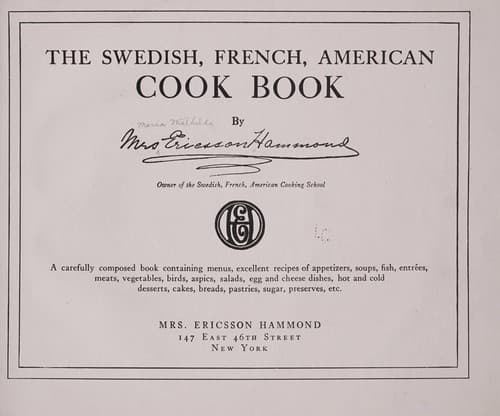
The Swedish, French, American cook book
1918Hammond, Maria Mathilda (Ericsson) Mrs. · 682 readable pages · 2,454 recipe records · formal French-influenced household and professional cookbook with alphabetical index
From the librarian's dossier · AI-generated, grounded in the scanned text
The Swedish, French, American Cook Book (1918) by Maria Mathilda (Ericsson) Hammond is a massive, professionally oriented culinary compendium that blends Swedish home cooking with the elaborate haute cuisine conventions of French service, adapted for American tables. Running to over 60 sections and spanning appetizers, soups, an enormous range of fish and shellfish, meats and game, poultry, eggs, cheese, vegetables, salads, sauces, frozen desserts, puddings, pies, cakes, breads, preserves, and confectionery, the book reads more like the working manual of a formal catering kitchen or cooking school than a simple household guide. Recipes are frequently named after individuals and places (a la Hammond, a la Ericsson Hammond, a la Walde, a la Gimo, a la Parisienne), suggesting a personalized recipe collection tied to the author's own circle, teaching practice, or professional acquaintances. The recurring use of aspic, gelatine, chaud-froid glazing, mousses, and timbales throughout nearly every category signals an emphasis on elaborate cold presentation suited to formal luncheons, dinners, and receptions of the era. Menus at the close of the book reinforce this orientation toward planned, multi-course entertaining. Modern readers will find a rich record of early twentieth-century upper-middle-class American dining as filtered through French technique and Swedish sensibility, offering both a culinary and social document of its time.
The book opens with a preface and a note on the author's cooking school class, then proceeds through appetizers (sections 1-4), soups and consommes (sections 4-7), an extremely long fish and shellfish sequence covering dozens of species from salmon and halibut to turbot, pompano, trout, codfish, eel, and shellfish such as lobster, shrimp, crab, oysters, clams, and terrapin (sections 7-20). This gives way to meats (beef, veal, sweetbreads, foie gras, lamb, mutton, pork, ham, sausage, tongue) in sections 20-27, then poultry and game birds in great depth (chicken, turkey, duck, goose, pigeon, squab, wild duck, pheasant, partridge, quail, woodcock, snipe, grouse, ortolans, plovers, venison, rabbit) across sections 27-37. Eggs, cheese, and vegetables follow (sections 37-43), then salads and sauces (sections 44-46), and an extensive dessert run covering frozen desserts, apple and fruit desserts, molded creams and charlottes, puddings, pies, and a long sequence of cakes, cookies, and pastries (sections 48-61). The book closes with breads and breakfast items, preserves and pickles, confectionery and candy work, reception menus, and a substantial multi-section alphabetical index (sections 62-69). Headings within sections are organized by main ingredient or dish category, often given in both French and English, with numbered variations (No. 1, No. 2, etc.) for popular items like mocha cake or shad roe preparations.
Recipes from this book
2,454 records extracted from the text, showing the first 20 in reading order. Each links to a modern interpretation.
Read the book
682 readable pages. A dot marks pages with recipe records.